- This Month in Saudi
- Posts
- This Month in Saudi: Ramadan Nights, Davos and Data Centers
This Month in Saudi: Ramadan Nights, Davos and Data Centers
Ramadan nights, desert art, data centers, and Davos diplomacy shaping Saudi Arabia’s next chapter.

January-February ‘26 Edition
Welcome back to This Month in Saudi!
Ramadan Kareem! Ramadan has just begun in Saudi Arabia, turning what was already a dense winter season into an even richer mix of spirituality, culture and night-time life. Days are slowing down and nights are filling with Ramadan tents, night markets, heritage souqs and cultural programming across Riyadh, Jeddah, AlUla and beyond.
Between 19 January and 18 February, the Kingdom also sent a heavyweight delegation to Davos, advanced AI and data-center financing, expanded AlUla and Diriyah’s cultural seasons, staged global events in Riyadh and Jeddah, and prepared for a “winter Ramadan” that will carry this momentum into March.
This edition walks through what happened across culture and places, tech and business, foreign affairs, and food, and closes with a calendar of what to catch next, with deeper dives you can explore on Saudi Streets.
In this issue…
Culture and Places: Desert X AlUla, Diriyah Season and Minzal, and new Ramadan-focused programming in Riyadh.
Tech and Business: A high-level Saudi delegation to Davos and the first net-zero AI campus at NEOM.
Foreign Affairs: Saudi’s messaging at WEF 2026, its use of Vision 2030 as a foreign-policy language, and how culture and mega-projects act as soft power.
What’s Coming Up: What to mark down from now into early spring, from Desert X AlUla and Diriyah Season to Ramadan programmes in Riyadh and beyond.
THIS MONTH IN CULTURE AND PLACES
Saudi’s cultural map keeps getting denser, and this month’s key stories came from AlUla, Diriyah, Al-Ahsa, Riyadh and Historic Jeddah, each leaning into its own heritage while experimenting with contemporary formats. For visitors, that means more reasons to look beyond a single city, and for editors, more proof that the cultural story is now truly national rather than limited to a handful of giga-projects.
AlUla: Desert X, art in the landscape and year-round culture

AlUla is moving firmly into a year-round cultural model, with festivals like AlUla Arts Festival and Desert X acting as peaks in a broader calendar that also includes exhibitions, residencies and heritage-focused programming. SPA and cultural reports describe open-air museums featuring rock inscriptions and historical writings, specialized exhibitions in visual arts, design, crafts, photography and film, and guided experiences that link archaeology with contemporary practice.
Desert X AlUla 2026, in its fourth edition, is running from 16 January to 28 February, turning the desert into a curated landscape of site-specific works that respond to themes of land, memory and community. From self-guided walking routes and open-top car tours to night-time visits and guided meditation sessions among the installations, Desert X is both an art event and a way of inhabiting the landscape.
For travelers, that means you can build an AlUla trip around Desert X and still have enough to fill days with hikes, stargazing, old-town walks and smaller exhibitions if you arrive outside headline festival days. For cultural practitioners, AlUla is becoming a reference point for how to use landscape as a medium rather than a backdrop.
Diriyah: Stargazing and Glamping

Diriyah Season 2025–2026, which runs until late March, continues to transform the historic cradle of the Kingdom into a dense ecosystem of night-time experiences, heritage walks and immersive stays. Programmes like Sada Al-Wadi in Wadi Safar, Layali Al-Diriyah in the historic districts, and workshops and performances across Samhan and other neighbourhoods are turning Najdi architecture and landscape into a live stage.
Our long-read on Diriyah Season 2025–2026 walks through how the festival uses Al-Murayih, Samhan and Wadi Safar differently: Al-Murayih as a hub for music, food and design; Samhan for more intimate performances and workshops; and Wadi Safar for poetry, Samri and story-telling against the valley backdrop. It also traces how the season is stretching across months, so residents and visitors can dip into it multiple times rather than treating it as a one-off weekend.
Within that broader season, Minzal has emerged as a signature cultural escape. Minzal ran from 1 January to 14 February, where guests moved between tented suites, fire-pit gatherings, curated food, art installations and guided activities that highlighted Najdi heritage and the surrounding landscape. Minzal was framed as a slower way of experiencing Diriyah: instead of a few evening hours, guests could stay overnight and feel the district as a lived environment.
Together, Diriyah Season and Minzal demonstrate how Diriyah is evolving into more than a restored historic site. It is becoming a place where heritage, hospitality and contemporary culture interact across different time scales, from nightly walks to full weekend stays.
Riyadh: Beast House Takes on Ramadan

In Riyadh, beyond mega-events and Diriyah, smaller cultural venues are shifting into Ramadan mode. Beast House is using the holy month for a programme of workshops, trivia nights, poetry gatherings, walking tours and film screenings that all start after iftar.
Beast House is part of a growing ecosystem of independent cultural spaces where residents can break their fast and then move into intimate, community-led activities rather than only large-scale festivals.
Combined with citywide Ramadan guides and night markets, these kinds of programmes show how Riyadh is developing layers of cultural life that exist between official seasons and the small-scale scenes that often go unnoticed.
THIS MONTH IN TECH & BUSINESS
Beneath the cultural and Ramadan stories, this month’s economic narrative focused on global positioning at Davos, AI and data-center infrastructure, and the maturing of giga-projects from headline announcements into long-term ecosystems.
Davos 2026: Vision 2030 on the global stage

From 19 to 23 January, Saudi Arabia participated in the World Economic Forum’s 2026 annual meeting in Davos under the theme “A Spirit of Dialogue,” with a high-level delegation that included Foreign Minister Prince Faisal bin Farhan, Tourism Minister Ahmed Al-Khateeb, Investment Minister Khalid Al-Falih, Finance Minister Mohammed Aljadaan, and other senior officials. Public statements framed Vision 2030 as a living example of long-term planning in an era of AI, climate transition and geopolitical fragmentation, stressing economic diversification, regulatory reform and job creation in emerging sectors.
Saudi’s representation emphasized themes of energy transition, innovation, AI governance and investment partnerships, with ministers spotlighting giga-projects, cultural investments and tourism as central to the future economy rather than peripheral. For observers, Davos reinforced that Vision 2030 has become the primary lens through which Saudi presents itself in global policy conversations.
NEOM and DataVolt: a 5 billion dollar green AI “factory”
NEOM announced that it has signed a landmark agreement with Saudi-based DataVolt to build what is billed as the region’s first net-zero AI data-center factory in Oxagon. Phase one of the facility, backed by an initial 5 billion dollar investment and designed to deliver 1.5 gigawatts of computing capacity, is expected to be operational by 2028.
Located on the Red Sea coast with access to subsea cables, renewable energy and green hydrogen, the Oxagon site will host a large-scale “green AI factory” that uses advanced cooling and is designed to run entirely on renewables, responding to the International Energy Agency’s warning that data centers already consume 1–1.3 percent of global electricity and will grow sharply with generative AI. NEOM and DataVolt frame the project as a foundational step in making Saudi a regional digital and AI hub, aligning data-hungry workloads with the Kingdom’s wider clean-energy ambitions.
For founders, creative studios and tourism operators, the implications are long term but could be profound if executed: AI and cloud capacity at this scale are the invisible backbone for more sophisticated personalization, real-time translation, immersive experiences and smart-city services across Saudi’s giga-projects.
World Defense Show and strategic industries
On the industrial side, World Defense Show 2026 in Riyadh, showcased Saudi defense innovations, emerging technologies and partnerships as part of the Kingdom’s plan to localise a significant share of defense procurement by 2030. The show brought together global manufacturers, local firms and policymakers, signaling that defense and security are not only strategic priorities but also industrial development drivers.
THIS MONTH IN FOREIGN AFFAIRS
Over the past month, Saudi Arabia’s external posture centered on three themes: consolidating its regional role, positioning itself in global conversations on AI and energy, and using culture and giga-projects as quiet instruments of soft power. Rather than big new doctrines, the signal was continuity and follow-through on the foreign-policy side of Vision 2030.
Vision 2030 as a global reference point
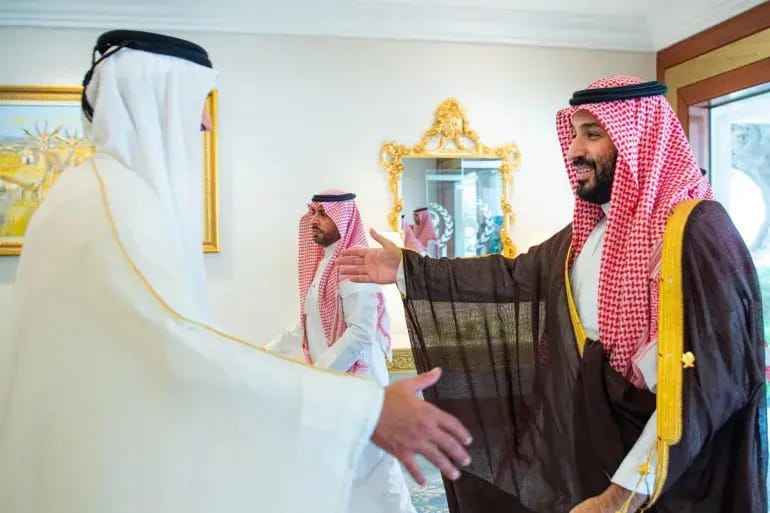
Saudi officials continued to frame the Kingdom as a stabilizing anchor in the Gulf and wider Middle East, using ministerial meetings and GCC coordination to reinforce shared positions on security, trade and energy. Public messaging repeatedly returned to themes of de‑escalation, economic integration and support for political processes in neighboring states, underscoring that regional stability is seen as a precondition for Vision 2030’s success.
In global forums and bilateral engagements this month, Saudi’s foreign-policy language increasingly blended AI, energy transition and economic diversification. Officials highlighted investment in renewables, hydrogen and digital infrastructure alongside continued leadership in traditional energy markets, pitching Saudi as a partner that can contribute to both energy security and net‑zero pathways.
Meanwhile, AlUla, Diriyah, NEOM and Qiddiya are now consistently referenced in foreign coverage as symbols of Saudi’s transformation, not just domestic projects. Partnerships with international museums, biennales, sports bodies and creative industries are being used to deepen ties with Europe, North America and Asia, turning cultural districts and mega-destinations into long-term platforms for exchange.
How to read this as a foreign affairs watcher
For diplomats and analysts, the key is to see Vision 2030 as an external as well as internal frame: it shapes how Saudi talks about AI governance, climate, trade and culture abroad.
For cultural and business institutions, the message is that engaging with Saudi increasingly means engaging with giga-projects, art and heritage programmes as much as with oil, arms or traditional diplomacy.
For your calendar
16 January - 28 February: Fourth edition of the contemporary art-in-the-landscape exhibition Desert X, part of AlUla Arts Festival, with large-scale installations, guided tours and night visits
30 January - 1 May: Diriyah Contemporary Art Biennale is here, bringing a major international art event that blends contemporary works with Diriyah’s historic setting, running day and night.
27 January - 11 April: Bedayat: Beginnings of Saudi Art Movement at the National Museum of Saudi Arabia in Riyadh honours early Saudi artists who shaped the country’s modern creative scene.