- This Month in Saudi
- Posts
- This Month in Saudi: Founding Day, Rockets Over Ramadan and Riyadh Rising
This Month in Saudi: Founding Day, Rockets Over Ramadan and Riyadh Rising
A Kingdom tested from the outside and transforming from within: Founding pride, regional fire, and the stories that defined Saudi Arabia's most charged Ramadan in years.
In partnership with


February-March ‘26 Edition
Welcome back to This Month in Saudi!
As this edition lands in your inbox, Saudi Arabia is in its first days of Eid Al-Fitr. This was not a quiet Ramadan. The holy month began on February 18 and almost immediately collided with a cascade of events that tested the Kingdom's composure: a jubilant Founding Day on February 22 lit the streets green, and then, just six days later, the United States and Israel launched strikes on Iran, pulling the Gulf into the most serious regional security crisis in years.
Saudi Arabia intercepted missiles and drones over Riyadh, the Eastern Province, and Jazan across multiple nights since then. And yet, beneath the air defense alerts and the diplomatic statements, life continued: restaurants filled after iftar, Saudi women reached a historic workforce milestone, the startup scene kept growing, and Eid was always on the horizon.
Between February 15 and March 19, the Kingdom offered, in miniature, everything it has become: a country that can hold Founding Day parades, host Arab foreign ministers in crisis talks, separate conjoined twins in a twelve-hour surgery, and turn its capital into a dining destination, all in the same thirty days.
This edition covers what happened across culture and places, tech and business, people, foreign affairs, and food, and closes with a calendar of what to watch next.
In this issue…
Culture and Places: Founding Day in Ramadan, Eid regional traditions across the Kingdom, and a restored historic mosque in Riyadh Province.
Tech and Business: Riyadh's startup boom and whether it is overtaking Dubai, PIF's strategic recalibration toward FIFA 2034 and Expo 2030, AI infrastructure accelerating, and Saudi's capital markets opening to all foreign investors.
People: Saudi women reach a record workforce milestone, and a Saudi medical team separates Somali conjoined twins in twelve hours.
Foreign Affairs: Saudi Arabia under fire from Iranian drones and missiles, its diplomatic balancing act, and a deepened strategic partnership with Egypt.
Food and Entertainment: Why Riyadh is becoming the Gulf's most ambitious dining city, and how Saudi became the world's new boxing capital.
What's Coming Up: Eid, Diriyah Biennale, and the year ahead.
THIS MONTH IN CULTURE AND PLACES
This was, by any measure, a layered month for Saudi cultural life. Founding Day arrived mid-Ramadan, adding national pageantry to an already charged spiritual calendar. Eid traditions were the subject of wide reflection as the holy month closed. And in Riyadh Province, a restored historic mosque quietly reopened.
Founding Day 2026: "Yawm Badina" Under the Crescent Moon

Saudi Arabia marked its 299th Founding Day on February 22, for the first time falling inside Ramadan since the Kingdom began observing the holiday in 2022.
Cities nationwide hosted large-scale activities, streets were decorated in green, and traditional attire was widely seen as Riyadh and other cities turned into cultural and tourism destinations, attracting thousands of citizens, residents, and visitors. This year's Founding Day coincided with the holy month of Ramadan, with events taking on a national and evening character in a Ramadan atmosphere.
The year's slogan, "Yawm Badina" (The Day We Began), framed the celebrations as a reckoning with nearly three centuries of history. In Riyadh, Qasr Al-Hukm and Justice Square hosted national events including the "Mikhyal Hal Al-Ouja" exhibition, which showcased stages of the Kingdom's founding through contemporary visual techniques. Riyadh Municipality decorated streets and main roads with more than 5,000 lighting installations across key axes, squares, and public spaces. Diriyah, as ever, served as the celebration's spiritual heart, with the At-Turaif UNESCO World Heritage Site hosting the main programming.
Saudi Streets examined the deeper historical question in Before the Kingdom: What Saudi Founding Day Really Marks, tracing the significance of 1727 as the chosen origin date of Saudi statehood and what that framing says about the Kingdom's evolving national identity. It is worth reading alongside the celebrations themselves, because the symbolism is as deliberate as the fireworks.
Eid Across Saudi Arabia: Why It Looks Different Depending on Where You Are
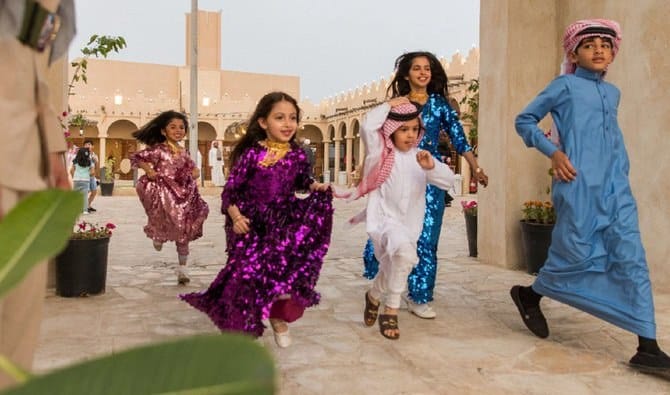
As Ramadan came to a close, Saudi Streets published a story of how Eid Al-Fitr is observed differently across the Kingdom's regions. Eid Across Saudi Arabia: How Different Regions Keep Old Traditions Alive traces the distinct rituals of Najd, Hijaz, Asir, and the Eastern Province, from the communal gatherings of the south to the pre-dawn preparations in coastal cities, showing how the same holiday carries entirely different textures depending on where you celebrate it.
For travelers timing a visit around Eid, the piece doubles as a practical map of where to go beyond the official programming.
Al-Mansaf Mosque: A Quiet Reopening in Riyadh Province

Away from the large-scale cultural events, a restored historic mosque quietly reopened in Riyadh Province in February. Al-Mansaf Mosque reopened after a careful restoration effort that preserved original architectural features while preparing the space for contemporary worshippers.
The reopening during Ramadan gave it a quietly charged meaning. These restoration projects, less visible than giga-project headlines, are part of how Saudi Arabia is building a relationship with its own built heritage at a human scale.
THIS MONTH IN TECH & BUSINESS
Is Riyadh Overtaking Dubai? Saudi Arabia's Startup Moment

The numbers are becoming difficult to ignore. Saudi Arabia's startup ecosystem now counts 85,000 active companies, with USD 3.4 billion in venture capital raised since 2023 across 1,200 deals, and a 55 percent share of all MENA venture capital funding for three consecutive years. Twelve unicorns now call the Kingdom home, with two more expected by December.
Saudi Streets examined the mechanics behind the boom in Saudi Arabia Startup Boom 2026: Is Riyadh Overtaking Dubai? Founders increasingly pick Riyadh over Dubai: Saudi venture capital firms write bigger cheques, USD 20 million to USD 50 million at Series A, with terms that prioritize long-term scale over quick exits. STV, MENA's largest tech-focused fund with USD 500 million under management, leads the pack, backed by stc Group and the Public Investment Fund.
PIF Recalibrates
By March 2026, the Public Investment Fund's new strategic direction has come into focus. The total value of construction contracts awarded fell to below USD 30 billion in 2025, a decline of nearly 60 percent from the USD 71 billion recorded in 2024.
But this is not a retreat: it is a recalibration. At the PIF Private Sector Forum in February 2026, Investment Minister Khalid Al-Falih confirmed a decisive shift in priorities, placing Expo 2030 and the 2034 FIFA World Cup at the top of the funding stack.
Saudi Arabia is expected to construct 15 stadiums for the World Cup, 11 of which are yet to be built, alongside associated transport, energy, and hospitality infrastructure. Industry estimates place stadium-related spending alone at approximately USD 25 to 30 billion.
=
On the AI side, the Saudi Data and AI Authority awarded a USD 2.7 billion contract for the 480MW Hexagon data center in Riyadh in January 2026. The Kingdom's ambition to develop between three and six gigawatts of AI computing capacity aligns with global benchmarks, where each gigawatt of data center capacity can require USD 30 to 50 billion in investment.
Saudi Capital Markets: Open to the World
From February 1, 2026, all categories of foreign investors gained the right to directly invest in Saudi-listed companies, removing long-standing restrictions, including the Qualified Foreign Investor framework, and permitting direct share ownership without intermediary structures.
With the Tadawul falling about 13 percent last year, "foreign inflows are no longer optional, they are needed," according to one Dubai-based investment analyst. The day after the announcement, Tadawul trading surged, with turnover exceeding 1.5 billion Saudi riyals in the first 30 minutes. Whether sustained capital follows will depend as much on the regional security picture as on market fundamentals.
THIS MONTH IN PEOPLE
Saudi Women Push to a Record High

Female labor force participation in Saudi Arabia climbed to 36.2 percent in Q3 2024, the highest figure on record. The latest Labor Market Bulletin from the General Authority for Statistics indicates years of policy reform under Vision 2030 are driving this upward trend.
For context, female participation stood below 20 percent in 2017. Vision 2030's target was 30 percent; the Kingdom has cleared it by a meaningful margin and kept climbing.
Twelve Hours in the Operating Theatre
In early March, a Saudi medical team completed a twelve-hour operation to separate Somali conjoined twins at King Abdullah Specialist Children's Hospital in Riyadh.
This is part of Saudi Arabia's long-running humanitarian medical program, which has treated patients from across Africa and Asia for decades. The surgery involved dozens of specialists across multiple disciplines and was successful. It is a reminder that some of the Kingdom's most enduring international relationships are built not in boardrooms but in operating theatres.
THIS MONTH IN FOREIGN AFFAIRS
Saudi Arabia and the Iran War

The defining story of this period arrived on February 28, when the United States and Israel launched strikes on Iran. Iranian forces reacted within hours, launching missiles in an operation named Operation True Promise IV, striking Israeli targets as well as multiple countries throughout the Persian Gulf region. Major targets included Bahrain's capital Manama, Kuwait International Airport, the UAE's capital Abu Dhabi, Riyadh and the Eastern Province in Saudi Arabia.
Saudi Arabia, despite having given Iran prior assurances that its airspace and territory would not be used to target it, found itself in the line of fire. On March 3, two Iranian drones struck the US Embassy in Riyadh, causing a fire and minor damage. On March 8, an Iranian drone strike hit a residential building in Al-Kharj, killing two people of Indian and Bangladeshi nationalities and injuring another twelve. By mid-March, the picture had intensified: the Saudi Foreign Ministry confirmed that Iranian strikes targeted the Riyadh region, the Eastern Province, and Jazan, which Saudi forces said were successfully intercepted. The ministry expressed strong condemnation, stating the strikes "cannot be justified or accepted under any pretext."
The Saudi cabinet stated it would take all necessary measures to defend Saudi Arabia's security, territory, citizens, and residents. Saudi Arabia further condemned "Iran's attacks on civilian airports and oil infrastructure, calling them a violation of international law and a deliberate attempt to destabilize the region."
Saudi Arabia's diplomatic response was careful and consequential. The Kingdom hosted a high-level meeting of Arab and Muslim-majority foreign ministers in Riyadh, aimed at building collective momentum toward a diplomatic off-ramp. The deeper impact of the conflict is on investor confidence: several European and American investment funds paused new capital deployment into Saudi projects, preferring a "wait and see" stance.
The most visible casualty so far has been the Formula 1 calendar. Formula 1 confirmed that the Saudi Arabian Grand Prix, scheduled for the Jeddah Corniche Circuit from April 17 to 19, will not take place, with no replacement events added to the season. The decision was taken in full consultation with the FIA and the respective promoters. F1 President and CEO Stefano Domenicali acknowledged the significance of the loss, noting that "Bahrain and Saudi Arabia are incredibly important to the ecosystem of our racing season," and said he looked forward to returning as soon as circumstances allow.
The cancellation matters beyond motorsport: the Jeddah Grand Prix had become one of the Kingdom's most globally visible annual events, drawing international visitors, broadcast audiences in the hundreds of millions, and the kind of organic soft-power reach that no government campaign can replicate. Its absence from the 2026 calendar is a concrete, quantifiable measure of the cost the Iran conflict is already imposing on Saudi Arabia's carefully constructed events economy, and a signal that the timeline for normalisation matters as much to the Kingdom's international image as it does to its security.
Vision 2030 was built on the promise of a Kingdom open for long-term investment; the weeks ahead will test how durable that promise looks to the outside world.
How to read this as a Vision 2030 watcher: The conflict has not derailed Saudi Arabia's domestic transformation programmes, and the Kingdom's air defense performance was widely noted as credible. But a sustained escalation would create pressure on oil logistics, tourism bookings, and FDI sentiment. The Kingdom's interest in a swift diplomatic resolution is acute and structural.
Saudi Arabia and Egypt: A Strategic Partnership Deepens
Amid the broader regional turbulence, Saudi Arabia and Egypt formalized a deepened strategic partnership in mid-March. This covers economic coordination, security cooperation, and cultural initiatives across the two largest Arab economies. Saudi Arabia has been one of Egypt's largest sources of financial support over the past decade, and the relationship carries weight as both countries navigate a region in flux.
1,000+ Proven ChatGPT Prompts That Help You Work 10X Faster

ChatGPT is insanely powerful.
But most people waste 90% of its potential by using it like Google.
These 1,000+ proven ChatGPT prompts fix that and help you work 10X faster.
Sign up for Superhuman AI and get:
1,000+ ready-to-use prompts to solve problems in minutes instead of hours—tested & used by 1M+ professionals
Superhuman AI newsletter (3 min daily) so you keep learning new AI tools & tutorials to stay ahead in your career—the prompts are just the beginning
THIS MONTH IN FOOD AND ENTERTAINMENT
Riyadh’s Restaurant Revolution

The capital's dining scene has become one of the Gulf's most interesting economic stories, and Saudi Streets traced it in depth: Riyadh's Restaurant Boom: How the Capital Became the Gulf's New Dining Powerhouse. Saudi Arabia's full-service restaurant market is projected to be worth more than USD 16 billion in 2025, growing to about USD 24 billion by 2030, with dine-in still accounting for roughly two-thirds of revenue despite the delivery boom.
From Bujairi Terrace in Diriyah, built as an open-air terrace of restaurants facing the mud-brick silhouettes of At-Turaif, to Solitaire Mall, a three-storey lifestyle complex set to host the London-born Arcade Food Hall and Paris' Perruche, the city is being replumbed so that restaurants are no longer scattered amenities but anchor tenants and, increasingly, the main event.
International chefs and brands that once chose Dubai as their MENA debut are making Riyadh their first call. For visitors planning a post-Eid trip, the KAFD pedestrian deck, Bujairi Terrace in Diriyah, and the emerging dining stretch in northern Riyadh are the three clusters that best capture what the transformation looks and tastes like.
Saudi Arabia: The World’s New Boxing Capital
Saudi Arabia's rise as a global boxing destination is no longer an emerging story; it is an established fact. Saudi Streets examined the trajectory in full: the Kingdom has hosted an accelerating roster of world championship bouts, with promoters, broadcasters, and fighters all treating Saudi Arabia as one of the sport's primary stages.
The commercial logic combines event revenue, broadcast rights, and the tourism and brand value that comes with hosting fights that reach audiences globally. For residents, it means a live fight calendar that would have been unimaginable a decade ago.
For your calendar
20 March: Eid Al-Fitr 1447 AH begins, with official holidays running through 25 March for most private sector workers.
30 January - 1 May: Diriyah Contemporary Art Biennale continues, blending major international contemporary works with the UNESCO heritage setting of At-Turaif. Day and night programming runs across the full calendar through May.
17–19 April (CANCELLED): Formula 1 has confirmed that the Bahrain and Saudi Arabian Grands Prix will not take place in April due to the ongoing situation in the Middle East.